
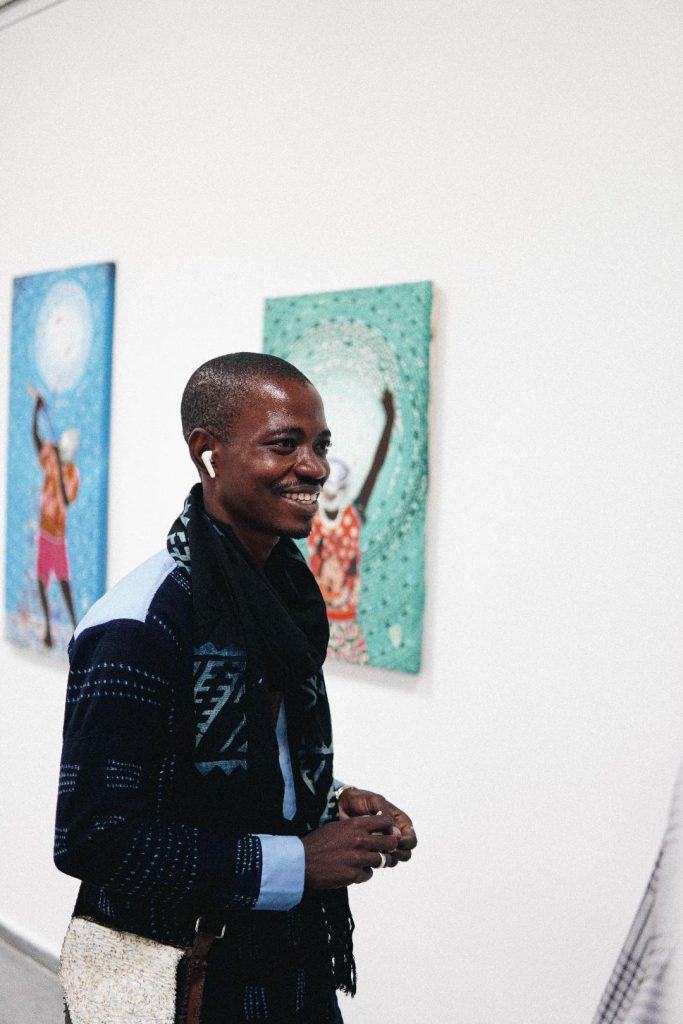
Nominee: Dramane Toloba
Category: Visual Artist of the Year
Country: Mali 🇲🇱
Art can do more than capture attention. It can question how society lives, challenge the way people consume, illuminate overlooked experiences and invite audiences to imagine a different future. For Malian contemporary artist Dramane Toloba, these possibilities are at the heart of his creative practice.
Through expressive paintings, unconventional materials and distinctive lamp-headed figures, Toloba explores the relationship between humanity, technology, the environment and society. His work brings together visual experimentation and social reflection, transforming discarded objects into artworks that invite viewers to look beyond the surface.
Nominated for Visual Artist of the Year at the WAFRIC Awards 2026, Toloba represents a contemporary African artistic practice that connects creativity with environmental responsibility and critical engagement with the world around us.
From Childhood Drawing to Professional Art
Toloba’s relationship with art began during childhood, when drawing was primarily a source of enjoyment. In an interview published by Maliweb, he recalled reproducing characters from comic books and cartoons. At that stage, becoming a professional artist was not necessarily his intended career path.
Following his secondary education, he initially pursued studies in economics and management in Bamako. His eventual move into formal art education came after an encounter with the possibilities offered by the city’s art school.
He subsequently gained admission to the Conservatoire des Arts et Métiers Multimédia Balla Fasséké Kouyaté (CAMM) in Bamako, where he studied visual arts and graduated in 2017 with a Master II in Plastic Arts, according to published profiles.
His academic journey across both management and visual arts provides an interesting context for his practice. His work is not limited to producing attractive images; it also engages with questions about the systems people build, the resources they use and the consequences of their choices.
Toloba is also associated with the Tim’Arts collective in Bamako, part of the community of artists contributing to Mali’s contemporary visual arts scene.
An Artistic Language Built from Reuse and Reinvention
One of the defining features of Toloba’s work is his approach to materials.
Rather than relying exclusively on conventional painting surfaces and supplies, he combines acrylic paint with recovered textiles, paper, papier-mâché, glue, paper clips and discarded beverage cans. These materials become part of the visual language of his compositions.
Recovered fabrics are particularly important to his process. He has described obtaining pieces from tailors, including wax print, bazin and satin, and incorporating them into his canvases through collage techniques.
This approach gives discarded or overlooked objects a new purpose. Materials that might otherwise be thrown away become components of artworks with aesthetic and conceptual significance.
For Toloba, recycling is therefore more than a practical production method. It is connected to an environmental outlook and a critique of a society in which consumption can generate large quantities of waste.
His practice demonstrates how an artist can work with what the surrounding environment provides, using imagination to transform familiar materials into something unexpected.
The Human Being in an Increasingly Technological World
Technology and the growing influence of machines on human life are among the recurring concerns in Toloba’s work.
His series “Les Humanoïdes”, exhibited at the Casa Blanca residence in Bamako in 2020, explored questions about humanity’s relationship with technological progress. The works invited viewers to consider what happens when technology becomes increasingly embedded in everyday life and whether the distinction between humans and machines may become less clear.
The series reflected a broader concern with the place of the human being in a rapidly changing world. Rather than treating technological advancement as an uncomplicated story of progress, Toloba uses art to raise questions about dependence, identity and the future.
His work does not require viewers to arrive at a single conclusion. Instead, it creates space for reflection about how technology should serve people, what may be lost through excessive dependence on machines and how modern life can remain connected to human values.
Lamp-Headed Figures and the Symbolism of Light
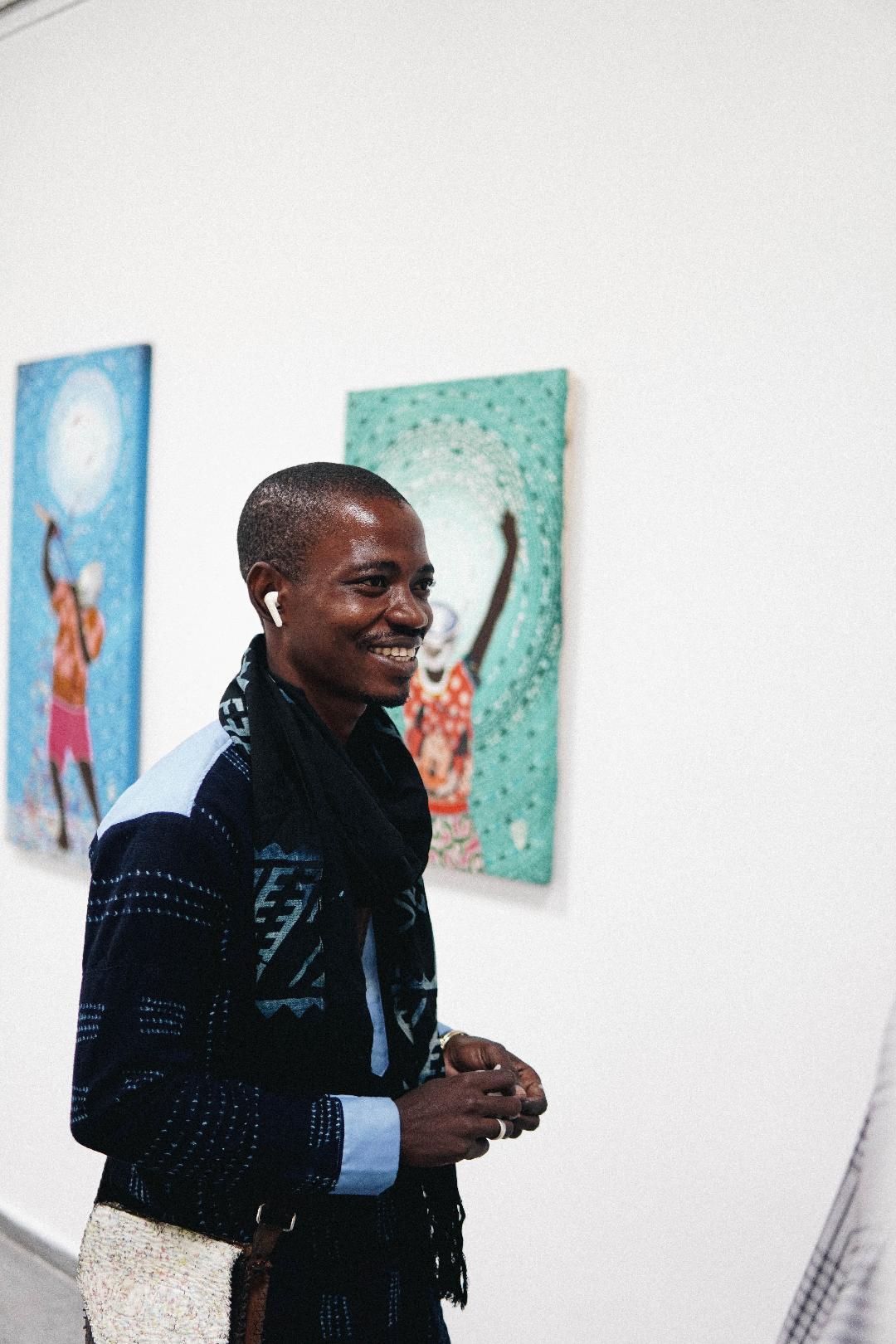
A recognisable feature of Toloba’s visual language is his use of figures with lamp-shaped heads. These unusual characters recur throughout his work and connect his imagery to questions of inner light, human potential, technology and the role of women in society.
As discussed in profiles by LouiSimone Guirandou Gallery and Artsy, the lamp-headed figures can be understood as an invitation to recognise the light within each person. Their presence also introduces an intriguing contrast: a lamp is an object associated with technology, yet in Toloba’s compositions it becomes part of the human figure.
The symbolism is particularly significant in works featuring female characters. These figures draw attention to the importance of women in Malian society while challenging viewers to reflect on their experiences, contributions and place in the wider social order.
The resulting imagery is imaginative without being detached from reality. Behind the distinctive forms are questions about human dignity, social roles and the relationship between people and the systems surrounding them.
Art as a Response to Environmental and Social Challenges
Toloba’s subjects extend beyond technology. His work addresses climate change, consumerism, overconsumption, women’s experiences and the challenges of governance, including corruption.
These themes connect the personal act of making art to wider public concerns.
His use of recovered materials, for example, brings the issue of waste into the physical construction of the artwork itself. Instead of merely depicting environmental problems, he incorporates discarded materials into an alternative creative process.
His treatment of social issues similarly invites audiences to look beyond appearances. Colour, texture and composition draw viewers in, while the underlying subjects encourage more considered reflection.
Colour plays an important role in this approach. In an interview with Maliweb, Toloba explained that colour choices depend partly on the weight of the subject being explored. He values colours that bring brightness and a sense of escape, particularly when addressing difficult realities.
This balance between serious subject matter and vivid visual expression is an important characteristic of his artistic identity.
Exhibitions and Recognition Beyond Mali
Toloba’s work has been presented through both individual and group exhibitions. Published profiles document exhibitions at venues including Galerie Médina, Casa Blanca, Taxi Bamako, the Club Américain and the Institut français in Bamako.
He has also participated several times in Ségou’Art, an important contemporary arts event in Mali.
His exhibition history extends internationally. Published accounts record presentations in France and Ecuador, including participation in the second World Arts Summit for Peace and Life in Ecuador.
His work has also been represented in international art platforms and collections. The Imago Mundi Collection, for example, documents his artwork The Flight of Peace, dated 2014, reflecting an earlier stage of his development as an artist.
These appearances situate Toloba within a wider conversation about contemporary African art, material experimentation and the capacity of visual practice to communicate across cultural and geographical boundaries.
A Notable Achievement in 2026: The Jigifa Bulon Award
Toloba’s recent recognition adds another important milestone to his artistic journey.
In February 2026, Mali’s newspaper L’Essor reported that he won first prize in the Jigifa Bulon initiative, a programme established by the Centre Soleil d’Afrique to support artists from Mali and Africa.
The initiative followed a call for projects launched in 2025, with selected projects subsequently recognised at an awards ceremony in Bamako.
This achievement is significant because it demonstrates recognition of Toloba’s work within a programme specifically focused on supporting artists and their projects. It also places his continuing practice within the broader effort to strengthen artistic activity and opportunities for creatives in Mali.
His nomination for Visual Artist of the Year at the WAFRIC Awards 2026 comes amid this wider body of artistic work, combining experimentation, social reflection and recognition within the creative sector.
Why Dramane Toloba Is a WAFRIC Awards 2026 Nominee
The Visual Artist of the Year category recognises creative expression and artistic contribution within West Africa’s diverse cultural landscape.
Dramane Toloba’s work brings together several compelling dimensions: a distinctive visual identity, an inventive approach to materials, environmental awareness and engagement with contemporary social questions.
His paintings challenge the assumption that discarded objects have no further value. His lamp-headed figures encourage reflection on humanity and technology, while his broader themes address women’s roles, climate change, consumerism and governance.
His documented exhibition experience and first-place recognition in the 2026 Jigifa Bulon initiative provide further context for his professional journey.
Through his nomination, WAFRIC Awards 2026 brings attention to a Malian artist whose practice demonstrates how visual art can combine experimentation with meaningful questions about the world we share.
Support Dramane Toloba
Dramane Toloba is representing Mali in the Visual Artist of the Year category at the WAFRIC Awards 2026.
To support his nomination, visit the official public voting platform:
Public voting runs from October 12 to November 15, 2026. Public votes contribute to the process but do not solely determine the winner. Final selection follows the published WAFRIC Awards procedures and criteria.
Read the full voting procedures here:
WAFRIC Awards 2026 — Recognizing the Unseen. Celebrating the Exceptional.